
Portrait of a U.S. Attorney, Between Past and Present
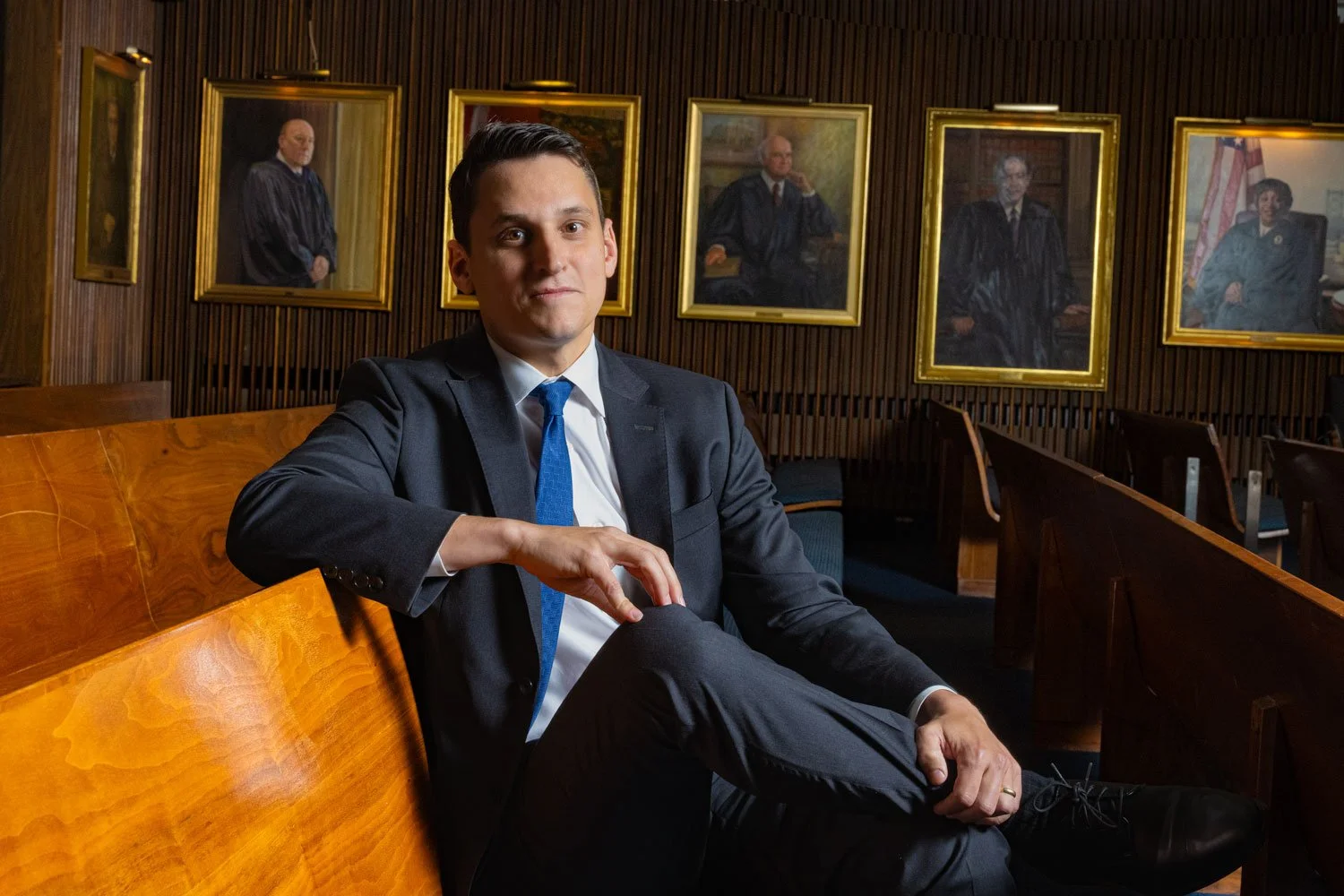
The investiture of a United States Attorney never feels routine to me. It’s this rare overlap of law, legacy, family, and quiet nerves, all contained in a single morning or afternoon. Over multiple administrations, I’ve been brought in every time a new president appoints a new U.S. Attorney, tasked with creating the black‑and‑white portraits that ultimately live in the U.S. Attorney’s office space. Those portraits are their own tradition: clean, archival, and consistent across the years, anchoring each administration in a visual line that runs through the office.
But David’s investiture gave me something I hadn’t experienced in quite the same way before. His ceremony took place in a ceremonial courtroom lined with oil paintings of past judges—faces that have watched over countless proceedings. Standing there, I felt the weight of that history pressing in from the walls. As I moved through the room, I suddenly saw a different kind of image in my mind, one that went beyond the usual candid coverage or the formal setups I’d done in the past. It was cinematic, almost like a frame from a film: David in the present, the judges in oil behind him, all in conversation with each other inside a single photograph.
I hadn’t planned that shot. It came to me purely in the moment. I glanced at the pews, the paintings, the light, and I realized I had a very narrow window to make it happen. Once the guests poured in, the courtroom would belong to the day—full of movement, hugs, laughter, and speeches. I knew I had to act before it transformed from a quiet, charged space into a full house.
So I went and asked for David right then, before the room filled up. That’s not something I have always done in the past; usually, I lean more on the flow of candid moments and scheduled portraits. But I’m in a different place now creatively. I’m thinking more about storytelling—about images that say something beyond “this happened.” He was incredibly gracious and flexible, and that made all the difference. We moved quickly into the spot I had envisioned, using the pews and those framed judges as part of the story. I positioned him, adjusted, and captured the portrait fast, conscious that his wife and four children, and all the guests, were waiting for him. It was important to me that this moment didn’t take him away from them for long.
That portrait feels like a bridge between the two worlds I work in. On one side, there is the ongoing assignment to create the black‑and‑white portraits that live in the U.S. Attorney office space every time a new administration comes in—images that are structured, consistent, and meant for longevity. On the other side, there is this more intuitive, cinematic approach that I’ve been deepening through my fashion catalog and editorial work, where I’m constantly building narrative and atmosphere. In the courtroom with David, those worlds met for a few minutes.
Most of my current focus is on fashion catalogs and lookbooks, which I find incredibly inspiring. I love the rhythm of working with teams, styling, and movement, and the way those shoots let me design an entire visual language for a brand. That practice feeds my eye for story, for composition, for how a person sits inside a space. When I come back into corporate and federal environments, I’m not switching off the artist to become “just a service provider.” I’m applying the same storytelling instincts in a context that values structure, discretion, and trust.
What I really appreciate about my corporate and institutional clients is how much they respect that creative side. They hire me because they know I can handle the pressure, the protocols, and the timing—and at the same time, they give me room to see differently. With the U.S. Attorney’s Office, that trust has been built over multiple administrations. They know I will deliver the expected black‑and‑white portraits for the office, but they also know I may find something unexpected along the way, like that portrait of David in the courtroom, surrounded by the painted gaze of past judges.
For me, that’s the balance: honoring the traditions and formal needs of the institution, while still allowing space for inspiration to slip in. Sometimes that looks like a carefully structured archival portrait destined for an office wall. Sometimes it looks like a quick, instinctive frame in a nearly empty courtroom before the rest of the day arrives. Both matter to me. Both are part of how I tell the story of who these people are, and where they stand in a long line of leadership.
Ready for professional photos instead of DIY experiments?
If you’re an aspiring model, actor, influencer, or brand and you’d like help planning a shoot, building your portfolio, or creating short-form video, the next step is easy
See session pricing and fill out my brief inquiry form → CLICK HERE
I’ll review what you send, get back to you with ideas and availability, and help you decide what fits best.
